Fractal Reptiles Based on Polyforms
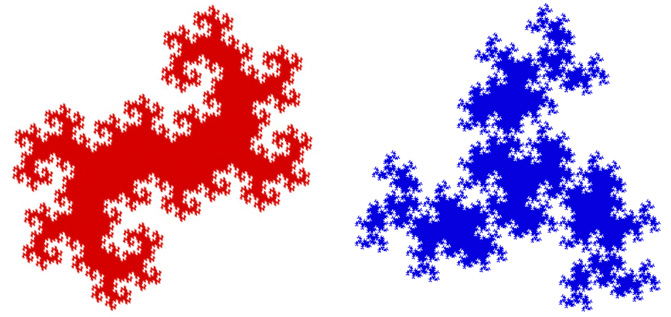
A self-replicating tile, or "reptile", is a tile that can be tiled by smaller copies of itself. Polyominoes, polyhexes, and polyiamonds are shapes comprised of squares, hexagons, and equilateral triangles, respectively, joined in edge-to-edge fashion. These polyforms can be arranged in ways that result in fractal reptiles in the limit of an infinite number of iterations. This process is described in detail in a 2025 paper dealing with polyominoes, by Robert Fathauer. Other polyforms, including polyiamonds and polyhexes, are dealt with in a 2026 paper. The method is described more briefly here.
For iterated tiles that neck down to single polygons or have single-polygon-wide gaps, there is a subtle problem with infinity. In the limit, these bridges and gaps go to zero, making the tile no longer a closed topological disk. At the same time, the tile only becomes self-replicating in the limit. So in some sense, these necking-down iterated polyforms are not fractal reptiles, though one can make an arbitrarily-good approximation to a fractal reptile.
The polyforms shown as buttons below link to pages with fractal reptiles based on them.




All content copyright Robert Fathauer
Fractal Diversions home
Fractal Tiling
 Fractal Knots
Gasket Fractals
Fractal Trees
Hyperbolic & Folded Fractals
Polyhedra
Papers
Fractal Knots
Gasket Fractals
Fractal Trees
Hyperbolic & Folded Fractals
Polyhedra
Papers